
Origin Story
Matrakçı Nasuh was a 16th century Ottoman polymath — soldier, mathematician, historian and, above all, one of the founders of the topographic miniature. His Beyân-ı Menâzil-i Sefer-i Irâkeyn-i Sultan Süleyman Han recorded, stage by stage, the route of Suleiman the Magnificent's campaign into Persia and Iraq between 1533 and 1536. Each miniature is both map and portrait: a city seen from above, with its mosques, walls, rivers and gardens laid out in patient detail.
The Meaning of the Pattern
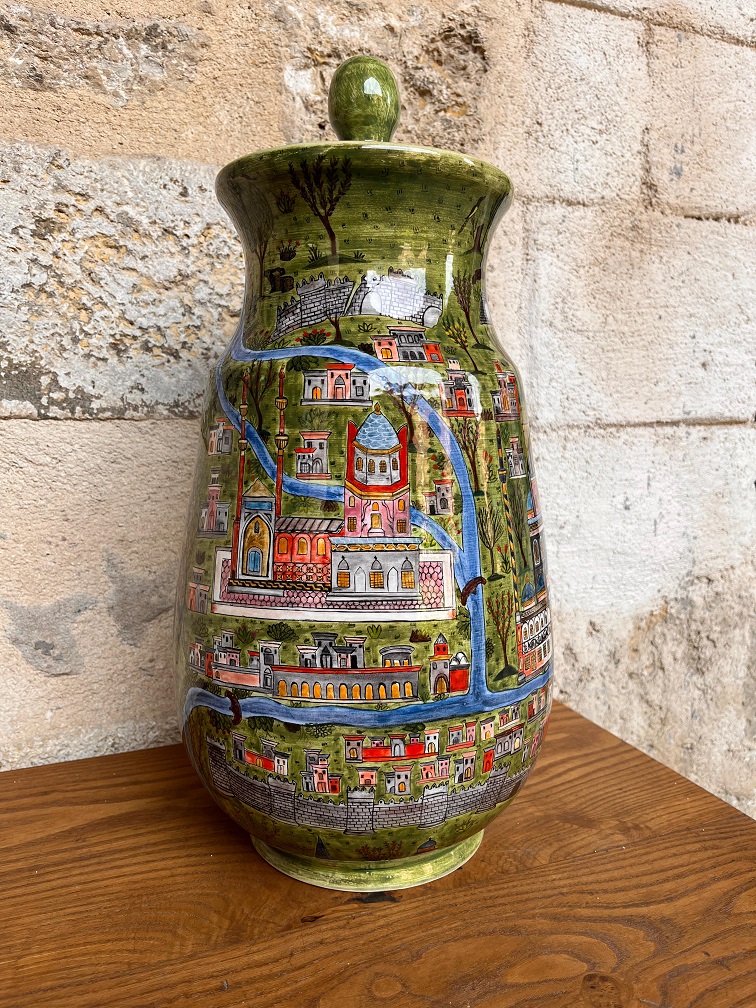
Matrakçı's miniatures are rare in Ottoman painting for their geographic intent. They are not simply decorative — they are documents. Carrying such a document onto a ceramic surface is a translation of genre: narrative becomes ornament without losing its precision. Walls, domes, cypresses and water meet the silhouette of the vase and arrange themselves along its curve.
The Çini Project Interpretation
The vase is wheel-thrown at 50 cm in a high-quartz body, then painted under the glaze. The palette remains faithful to the Iznik language of the period — cobalt, turquoise, red and manganese — so the miniature does not arrive on the vessel as a reproduction but as a piece already native to the medium. History approaches the viewer from the surface of a single object.
Signatures
Application: Merve Erbaş
Design adaptation: Çini Project studio