
Origin Story
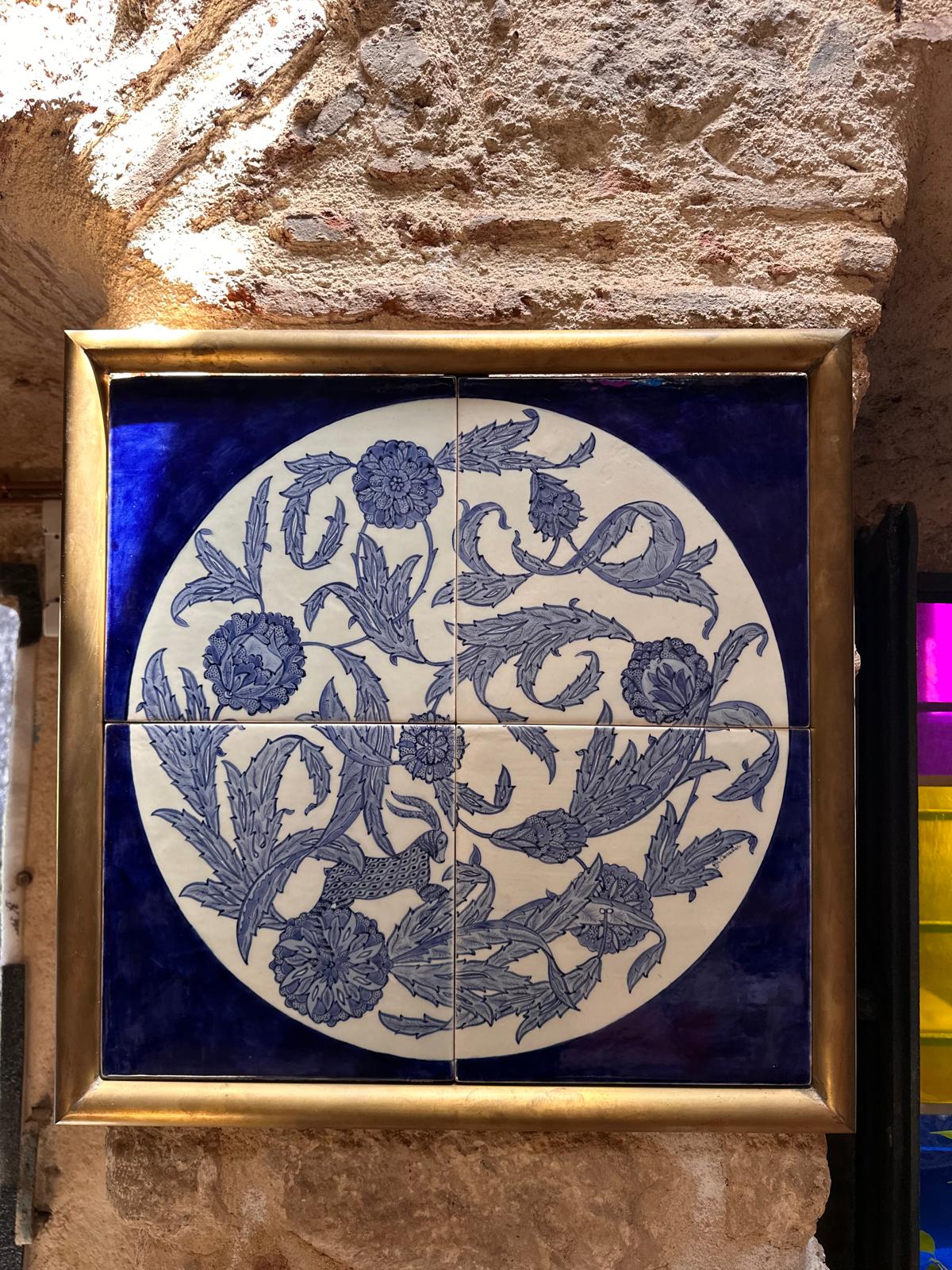
The Sazyolu style takes its name from the reed-like curved lines (saz) that carry its compositions. Its master, Şahkulu, was head of the Ottoman court nakkaşhane in the 16th century; under his hand, floral decoration broke out of the strict grids of earlier ornament and took on a new, almost calligraphic freedom — long leaves curved across the page, narrow branches carried imagined flowers, and the composition breathed.
The Meaning of the Pattern
Sazyolu is sometimes read as Ottoman ornament's first truly expressive mode: the line admits movement, without surrendering discipline. In an interior, a Sazyolu surface is never merely decorative — it sets a tempo for the room.
The Çini Project Interpretation
The panel is produced as a single 50 × 50 cm stone tile in a high-quartz body, painted under the glaze in the classical Iznik palette. The composition is laid out so the curved saz-lines read continuously from side to side — the eye enters, travels and returns — and the whole is finished inside a brass frame designed by Doğan Ergen, tuned to the weight of the tile. The panel is intended to give identity to a wall: above a console, in an entrance hall, at the head of a dining space.
Signatures
Application: Çini Project studio
Brass framework: Doğan Ergen